
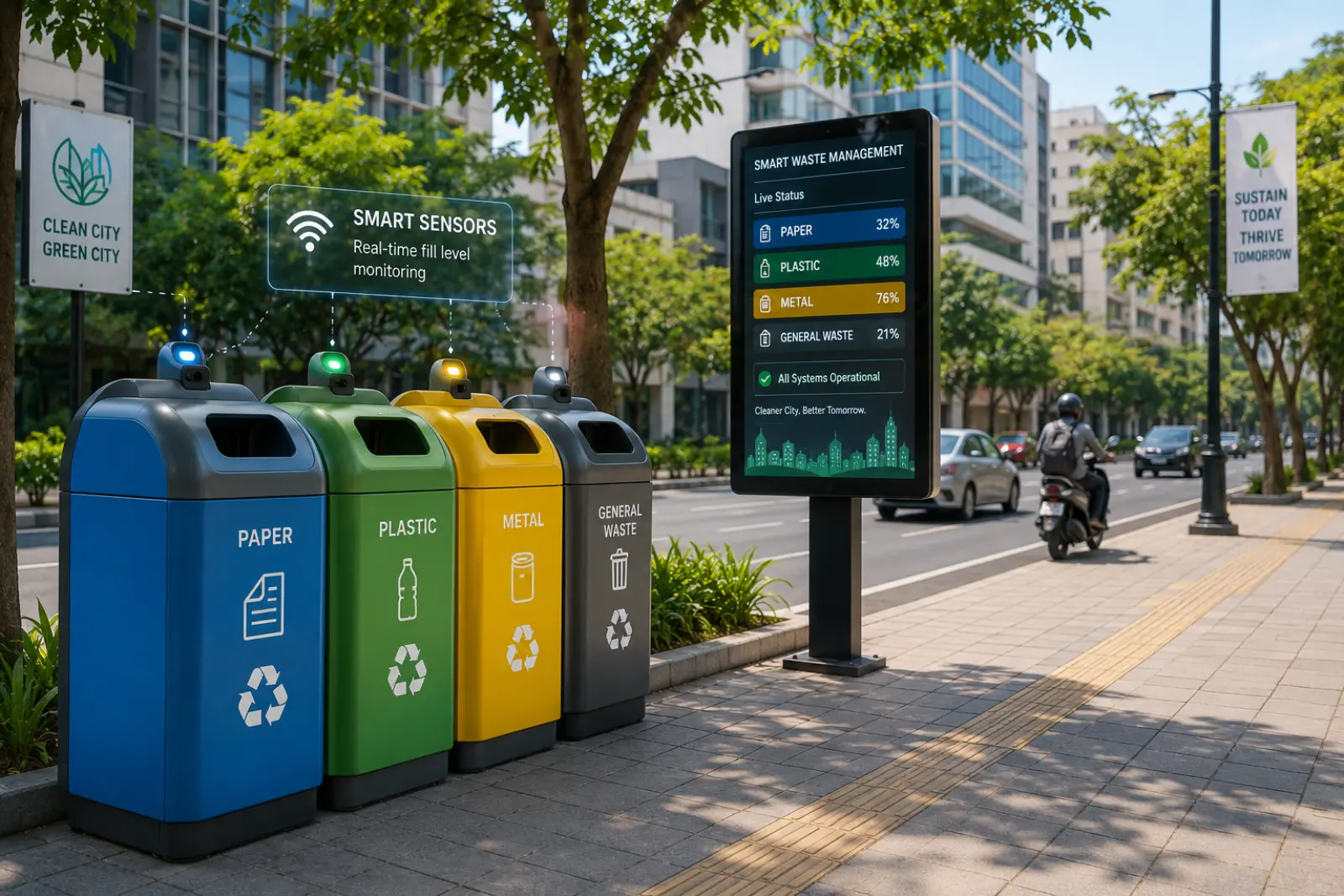
India’s urban centers are embarking on a high-tech “cleanup” mission. As the country’s population urbanizes, managing millions of tons of daily waste has become a critical operational challenge. City administrations are tackling this by deploying Smart Waste Management networks – integrating IoT, data analytics, and decentralized circular processing to turn waste into a valuable economic resource.
IoT-Enabled Collection Networks
The backbone of the smart waste system is the “sensor-equipped bin”. Smart dustbins are now fitted with ultrasonic fill-level sensors that transmit data to municipal command centers in real-time. Garbage trucks no longer follow rigid, inefficient routes; instead, they are dynamically dispatched only to bins that are nearing capacity. This significantly reduces fuel consumption, traffic congestion, and operational costs.
Decentralized Circular Processing
Smart cities are shifting away from massive, overflowing landfills located on the city outskirts. Instead, they are implementing decentralized waste processing hubs.
- Bio-Methanation Plants: Organic, wet waste is processed in localized neighborhood plants, where it is converted into biogas that powers streetlights, local markets, and public transit.
- Digital Material Recovery: Advanced automated sorting facilities utilize AI-powered visual recognition to separate plastic, paper, and metal from dry waste with high precision, ensuring these materials are successfully channeled back into the industrial manufacturing cycle.
By treating waste as a localized asset rather than a municipal liability, Indian cities are setting a global example for urban sustainability.