
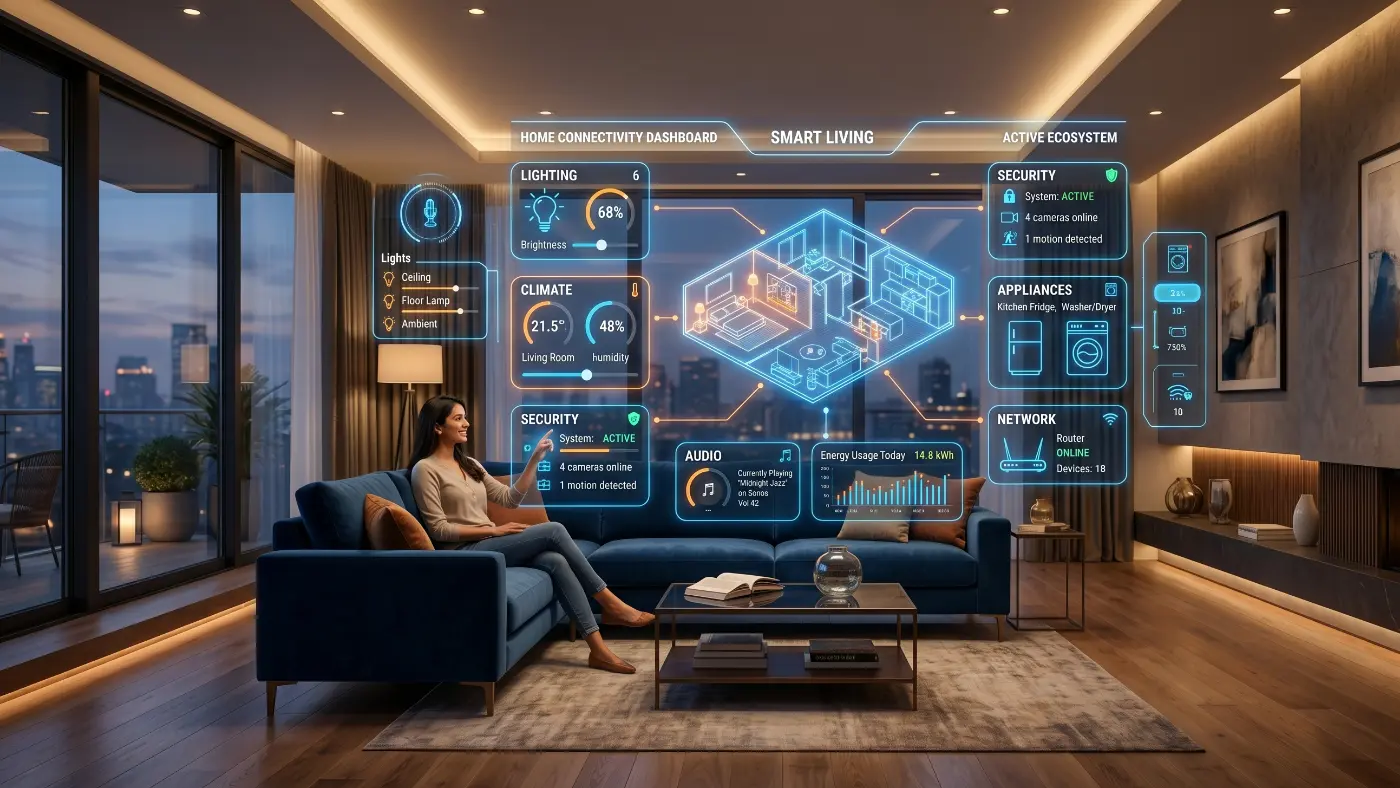
Building a smart home used to feel like an complex science experiment. You would buy a smart bulb from one brand, a security camera from another, and quickly realize they refused to talk to each other. Today, the landscape is entirely unified thanks to universal standards like Matter, making it easier than ever to build an automated living space.
If you are planning to build or upgrade your smart home, choosing the right foundational ecosystem is your very first step. Here are the top 5 smart home ecosystems evaluated for compatibility, ease of use, and automation intelligence.
1. Apple Home (HomeKit)
Apple Home remains the gold standard for users deeply integrated into the iOS ecosystem. Its standout feature is its uncompromising approach to privacy and local security; most automation processing occurs locally on your HomePod or Apple TV hub rather than a distant cloud server. With Matter support fully implemented, the historical limitation of “limited compatible devices” is gone, though it still requires an Apple device to set up and manage.
2. Google Home
Google Home excels at contextual intelligence and voice recognition, driven by its advanced Gemini-powered assistant models. It is highly flexible, working flawlessly across both Android and iOS devices. Google Home’s automated “Routines” are incredibly intuitive, allowing you to easily program complex chains of events – like lowering the blinds, dimming the lights, and starting your vacuum cleaner with a single morning command.
3. Amazon Alexa
Amazon Alexa boasts the widest out-of-the-box device compatibility of any ecosystem on the market. From smart microwaves to high-end smart locks, almost everything “Works with Alexa”. It is an excellent ecosystem for budget-conscious builders who want to mix and match hardware from third-party manufacturers without worrying about connectivity hurdles.
4. Samsung SmartThings
Samsung SmartThings is the power-user’s dream. While it features a user-friendly app interface, its underlying automation engine allows for incredibly complex conditional scripting (e.g., “If motion is detected past 11 PM, AND the front door is unlocked, THEN turn the bedroom lights red and send a notification”). It also integrates natively with Samsung’s extensive line of smart home appliances.
5. Home Assistant (The Open-Source Titan)
For absolute control, privacy, and local automation without any corporate cloud dependencies, Home Assistant is unrivaled. It requires a bit of technical know-how to set up (typically running on a local Raspberry Pi or home server), but it allows you to connect absolutely any device from any manufacturer into a single, beautifully customized dashboard.