As humanity prepares for long-duration crewed expeditions to Mars and establishes permanent science hubs on the Moon, an invisible technological hurdle must be overcome: communication infrastructure. For over half a century, space agencies have relied exclusively on radio frequencies to talk to spacecraft. However, as deep-space missions demand massive data capabilities, traditional radio grids are approaching a hard physical limitation. The future of cosmic conversation rests on Deep Space Laser Telecommunications.
The Bandwidth Bottleneck of Radio
Standard radio transmissions scatter widely across deep space. By the time a radio signal traveling from Mars hits the Earth, its footprint is wider than the planet itself, resulting in an incredibly weak, low-data stream. Downloading a single high-definition image from a Martian rover using radio frequencies can take several hours. If a crewed mission needs to stream high-definition video, send complex medical telemetry, or transmit massive geological maps, radio is simply too slow.
The Laser Revolution (Optical Communications)
Deep space laser systems utilize near-infrared light instead of radio waves to encode and transmit data. Because infrared light has a much higher frequency than radio waves, it can pack significantly more information into a single transmission.
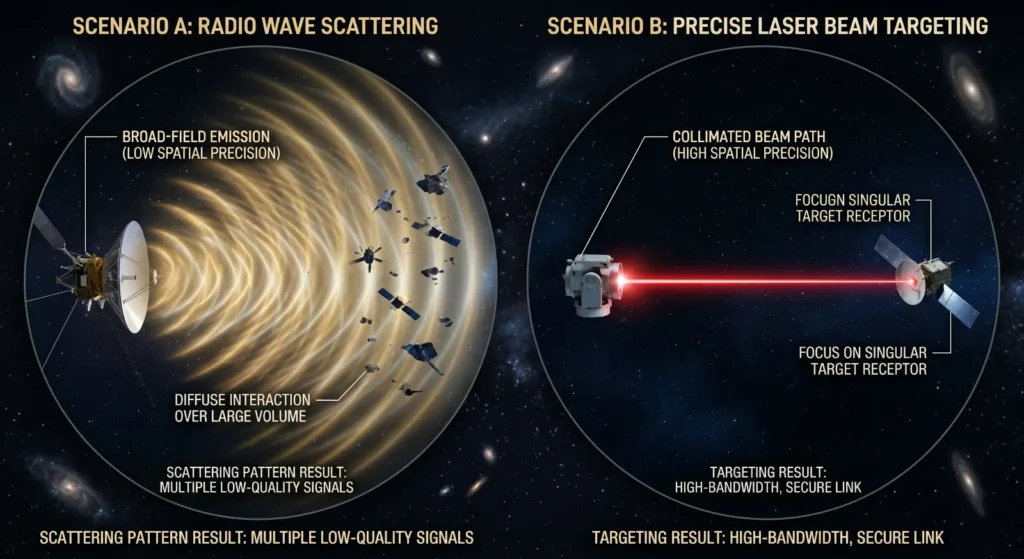
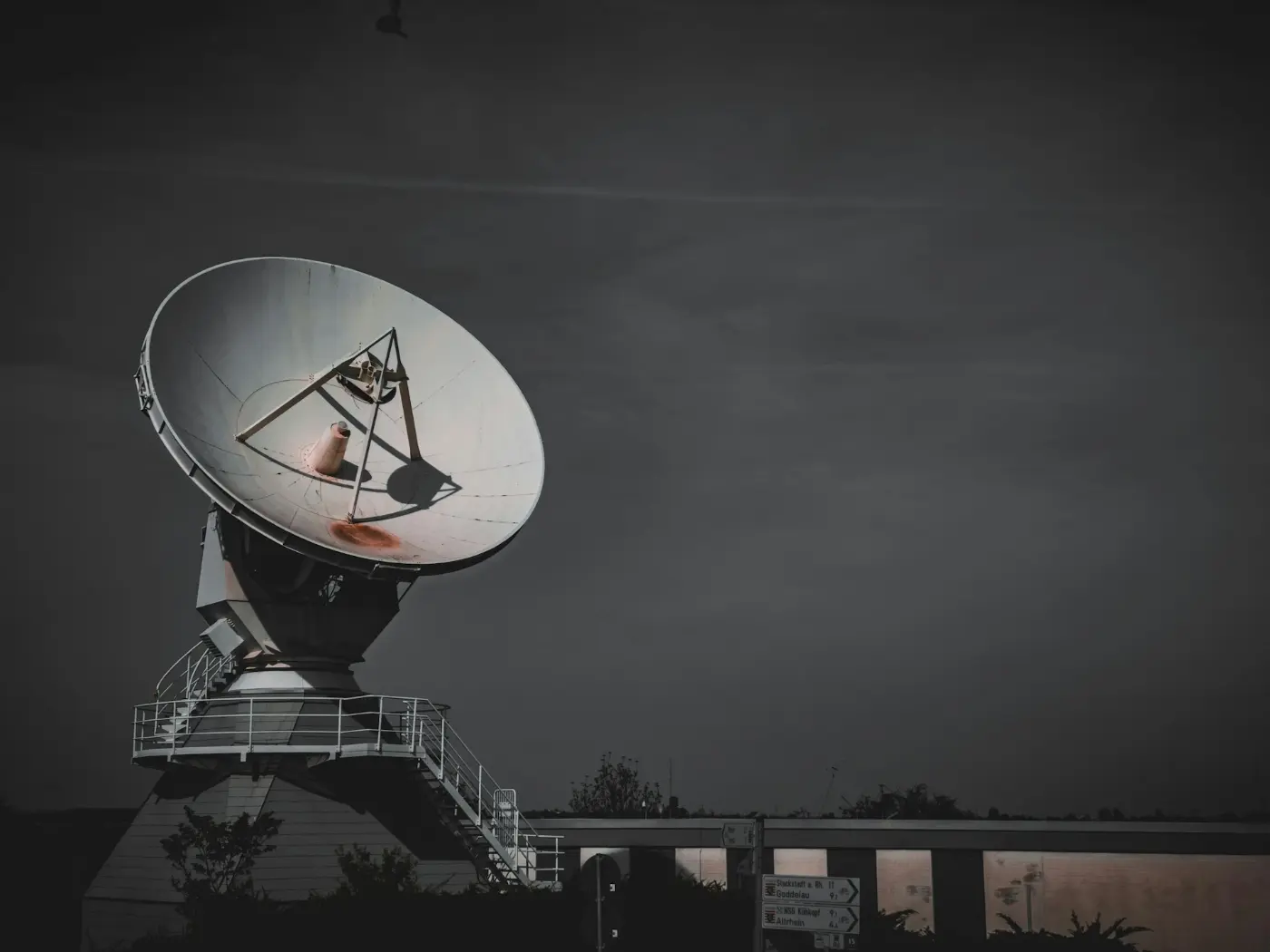
- Unmatched Precision: Unlike radio waves that disperse broadly, a telecommunication laser beam remains tightly focused, concentrating its energy directly into an optical receiver dish on Earth or a relay satellite in orbit.
- Exponential Speed Multipliers: Laser communication tests have successfully demonstrated data transmission speeds up to 10 to 100 times faster than current radio networks, allowing deep-space networks to transmit complex files in minutes instead of days.
- Weight and Power Efficiency: Laser hardware is significantly lighter and consumes less electricity than bulky radio transmitters, saving precious weight and space inside the primary spacecraft payload.
Navigating the Atmospheric Hurdle
The primary challenge of optical space communications is Earth’s atmosphere. Heavy cloud cover, dense fog, and rain can disrupt, absorb, or scatter laser light, breaking the transmission link.
To bypass this operational bottleneck, space networks are deploying a “Hub-and-Spoke” architecture: laser signals from deep space are captured by an interconnected network of relay satellites stationed high above the cloud line in Earth’s orbit, which then seamlessly pass the clean data down to ground stations via traditional, weather-resistant radio frequencies.