With Apple’s annual autumn hardware keynote approaching in September 2026, a surge of supply-chain dispatches, CAD renders, and diagnostic logs from chip foundries and camera component partners – including TSMC, Sony, and Tata Electronics – has provided an in-depth preview of the upcoming iPhone 18 Pro and iPhone 18 Pro Max.
The 2026 flagship lineup represents one of Apple’s most substantial technical overhauls in years. Transitioning to TSMC’s 2-nanometer A20 Pro processor, a mechanical variable-aperture 48MP primary camera, a 35% smaller Dynamic Island, and an upgraded in-house C2 5G satellite modem, the iPhone 18 Pro series introduces major changes to mobile processing, computational photography, and on-device AI efficiency.
Furthermore, reports indicate Apple is adjusting its product release cadence. The premium iPhone 18 Pro, iPhone 18 Pro Max, and the long-rumored foldable iPhone Ultra are expected to debut in September 2026, while standard base models like the standard iPhone 18 and iPhone 18e are reportedly scheduled for launch in spring 2027.
Hardware Overview: iPhone 18 Pro vs. iPhone 17 Pro
| Hardware Parameter | iPhone 17 Pro (2025 Generation) | iPhone 18 Pro (Leaked 2026 Model) |
| Processor Node | A19 Pro (3nm Lithography) | A20 Pro (TSMC 2nm Lithography) |
| Chip Packaging | InFO-PoP Architecture | WMCM (Wafer-Level Multi-Chip Module) |
| Main Camera Sensor | 48MP Sony IMX903 (Fixed $f/1.78$) | 48MP Sony IMX905 (Variable Aperture) |
| Front Cutout / Island | Standard Dynamic Island (20.7mm) | 35% Narrower Dynamic Island (~13.5mm) |
| Cellular Modem | Third-Party 5G Modem | Apple C2 Custom Modem (5G Satellite Data) |
| Cooling Architecture | Standard Graphite Sheet Layer | Thicker 0.25mm Vapor Chamber System |
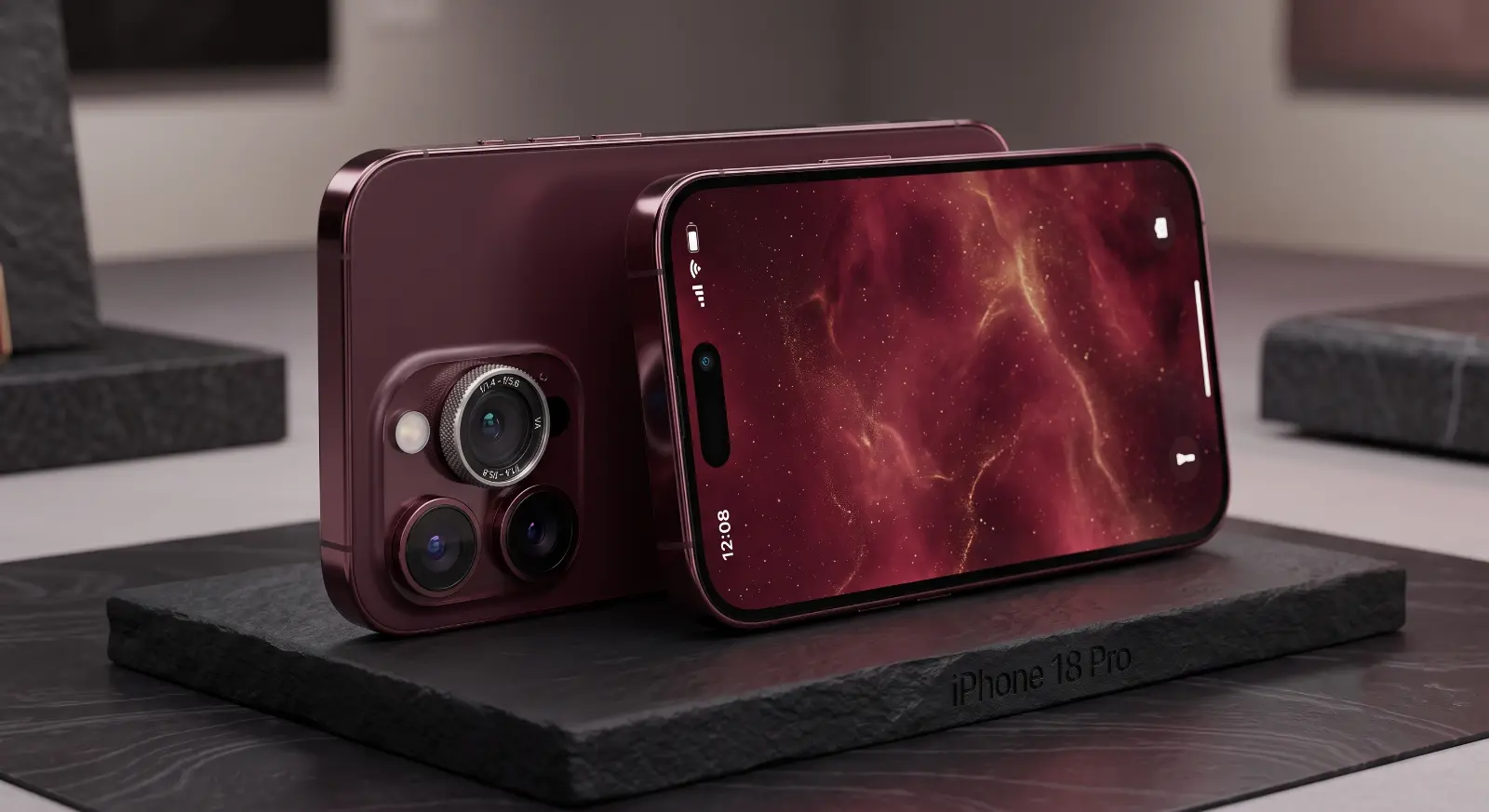
| Special Finish Option | Cosmic Orange | Dark Cherry (Burgundy with Purple Tints) |
1. The TSMC 2nm Silicon Upgrade: A20 Pro & WMCM Architecture
The core performance gain for the iPhone 18 Pro comes from the new Apple A20 Pro chipset. Manufactured using TSMC’s 2-nanometer (N2) process node, the A20 Pro represents Apple’s shift beyond the 3nm architecture used in prior generations.
By packing a significantly higher density of transistors onto the silicon substrate, the A20 Pro is expected to deliver:
- Enhanced Processing Speeds: Faster multi-core CPU and GPU performance for gaming, real-time spatial video rendering, and multi-tasking.
- Improved Thermal and Power Efficiency: Up to 20-30% reduction in power consumption during intensive workloads, helping extend daily battery longevity.
WMCM Integration for On-Device Apple Intelligence
Alongside the 2nm transition, Apple is reportedly adopting Wafer-Level Multi-Chip Module (WMCM) packaging for the A20 Pro. Instead of housing memory and processing cores on separate layers, WMCM integrates the CPU, GPU, Neural Engine, and RAM directly onto the same wafer substrate. This design minimizes internal communication latency and expands memory bandwidth, enabling complex iOS 27 Apple Intelligence AI models to execute locally on the device.
2. Camera System Overhaul: Sony IMX905 & Variable Aperture
For photography enthusiasts and content creators, the camera array on the iPhone 18 Pro brings one of the most notable hardware updates in the lineup.
Supplier leaks indicate that both the iPhone 18 Pro and iPhone 18 Pro Max will feature a new 48-megapixel Sony IMX905 main sensor equipped with physical variable aperture technology.
Understanding Variable Aperture:
Rather than relying on a fixed physical lens opening, a variable aperture uses motorized internal blades to dynamically adjust light intake.
- Low-Light Settings: The lens opens wider to capture more ambient light, minimizing visual noise and motion blur.
- Bright Lighting & Group Shots: The lens aperture narrows to increase the physical depth of field, keeping subjects across multiple focal planes sharp without relying purely on software portrait mode blur.
Complementing the variable aperture main camera is an upgraded 48MP Ultra-Wide sensor and a 48MP tetraprism Telephoto lens featuring a wider physical aperture for clearer long-range zoom photography in low light.
3. Design Adjustments: Under-Display Face ID & Dark Cherry Finish
While keeping the general titanium chassis and flat-edge design of recent Pro models, the iPhone 18 Pro introduces visible refinements to both the front display and rear glass.
Compact Dynamic Island
According to display supply-chain reports, Apple has successfully repositioned select Face ID infrared emitters beneath the active OLED screen. This shift allows the physical cutout of the Dynamic Island to shrink in width by roughly 35% (down to ~13.5mm from 20.7mm), freeing up additional visible screen real estate on the 6.3-inch and 6.9-inch LTPO+ Super Retina XDR displays.
Revised Rear Finish and New Colorway
To create a more seamless appearance between the back panel and the raised camera plateau, Apple has adjusted the frosted Ceramic Shield rear glass to match the anodized aluminum frame texture more closely.
Reported color options for the iPhone 18 Pro series include:
- Dark Cherry (Headline Color): A rich, deep red shade featuring subtle purple undertones under direct light.
- Light Blue: A muted, icy metallic blue option.
- Dark Gray: A classic, dark slate black finish.
- Silver: A clean, natural metallic shade.
4. Extended Battery & Vapor Chamber Thermal Management
To support the heavy thermal output of high-bandwidth AI computing and AAA mobile gaming, the iPhone 18 Pro incorporates a newly designed vapor chamber cooling system. The inclusion of this internal cooling plate adds approximately 0.25mm to the overall thickness of the phone.
Leaked Battery Capacities
- iPhone 18 Pro (6.3-inch): ~4,056 mAh to 4,288 mAh
- iPhone 18 Pro Max (6.9-inch): ~5,200 mAh to 5,567 mAh
Combined with the power savings of the 2nm A20 Pro chipset and power-efficient LTPO+ display controllers, the iPhone 18 Pro Max is expected to achieve extended battery endurance, delivering up to 30+ hours of continuous video playback on a single charge.
5. Apple C2 In-House Modem & 5G Satellite Connectivity
The iPhone 18 Pro lineup is also slated to introduce Apple’s second-generation custom C2 5G modem. Designed to reduce reliance on third-party silicon, the C2 modem lowers power consumption during high-speed cellular data usage.
Additionally, leaks indicate the C2 modem expands satellite capabilities beyond basic SOS emergency messaging. The new hardware will support 5G satellite data connections, allowing users to send text messages, load basic map coordinates, and update location metrics even when completely disconnected from terrestrial cellular networks.
Expected Pricing and Launch Window
Given the increased manufacturing costs associated with 2nm silicon wafers and advanced camera modules, market analysts anticipate a minor price adjustment for base storage tiers.
- iPhone 18 Pro (256GB Base): Expected to start around $1,099 USD / ₹1,39,900 INR
- iPhone 18 Pro Max (256GB Base): Expected to start around $1,299 USD / ₹1,54,900 INR
Apple is widely expected to unveil the iPhone 18 Pro series during its annual fall keynote event, projected to take place between September 8 and September 10, 2026, with pre-orders and global retail availability following shortly after.