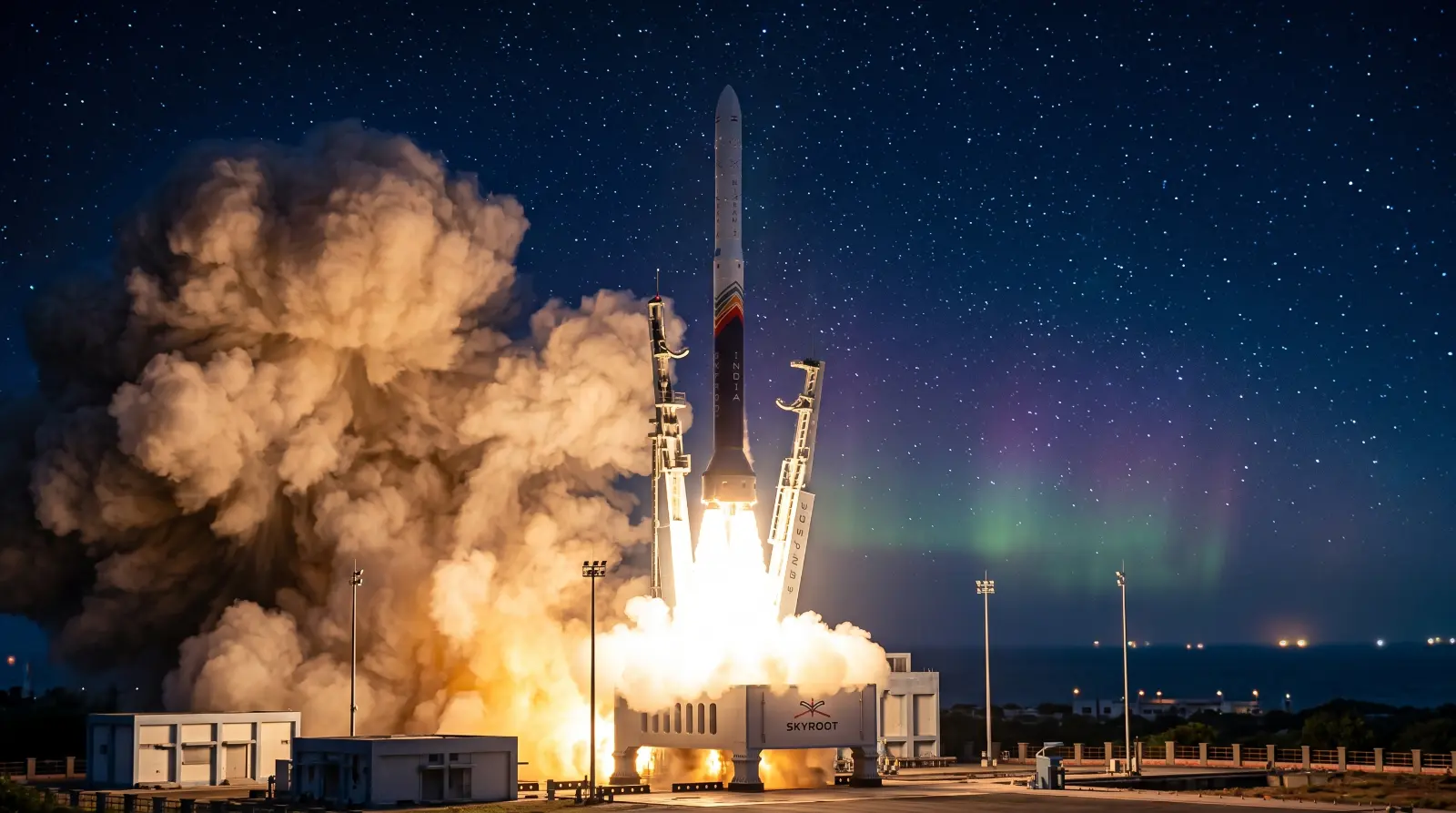
India has firmly established itself as an absolute global leader in the commercialized space domain, unlocking a massive new era of private sector innovation. On July 18, 2026, home-grown aerospace pioneer Skyroot Aerospace carried out the successful Vikram-1 private rocket launch. Dubbed officially as ‘Mission Aagaman’ (meaning arrival), the heavy-duty orbital mission successfully placed multiple high-tech technology demonstration payloads and symbolic digital postcards – including messages from Prime Minister Narendra Modi – directly into a pre-calculated low Earth orbit (LEO).
The phenomenal success of this orbital injection positions India within an elite, highly restricted circle of global nations possessing independent, privately developed orbital-class launch capabilities. By scaling beyond sub-orbital technology demonstrators and successfully entering the complex arena of multi-stage orbital velocity delivery, the domestic startup ecosystem has proven it can reliably execute advanced commercial cargo flights at a fraction of the cost logged by traditional international legacy corporations.
The Technical Profile: Inside the All-Carbon Multi-Stage Booster
To fully comprehend the deep engineering victory behind the Vikram-1 private rocket launch, one must analyze the unique materials and structural parameters embedded within the rocket’s design. Unlike conventional metal-bodied rockets that carry immense dead weight, the Vikram-1 architecture is built utilizing an ultra-advanced, high-durability carbon-fiber composite structure.
The multi-stage launch vehicle leverages cutting-edge 3D-printed liquid and solid propulsion components designed to withstand severe mechanical strain.
The successful mission validated three critical proprietary technological subsystems built entirely in-house by the domestic startup:
- 3D-Printed Cryogenic Valving: The upper-stage liquid engines utilize specialized, rapid-manufactured components that drastically compress the traditional manufacturing supply timeline from months down to a single weekend.
- Autonomous Avionics Suite: The vehicle’s flight path calculations were entirely managed by an integrated, AI-driven onboard computer system capable of executing real-time atmospheric steering adjustments without waiting for ground control commands.
- Advanced Stage Separation: The delicate structural transition phases between the high-thrust solid booster stages were executed with absolute synchronization, ensuring zero cargo destabilization during the climb into low Earth orbit.
The Commercial Blueprint: Lowering the Invoicing Cost of Space
The absolute strategic fallout of the successful Vikram-1 private rocket launch shifts the balance of commercial satellite deployment across the Asia-Pacific region. Until now, global small-satellite manufacturers were forced to queue up for years to catch a “rideshare” slot on massive, state-run rockets, exposing their corporate timelines to heavy bureaucratic updates.
By offering a dedicated, customizable, and rapid-response launch solution, the private sector can now target the multi-billion dollar commercial constellation market. International communications firms, weather tracking panels, and agricultural monitoring groups can purchase individual orbital insertion packages tailored precisely to their desired inclination profiles.
With the Indian Space Promotion and Authorization Centre (IN-SPACe) providing streamlined legal support and operational infrastructure tracking, the country has made it explicitly clear to global markets that its silicon ambitions are permanently matched by a robust, low-cost logistics pipeline leading straight into orbit.