A terrifying wave of explosive kinetic warfare has shattered the night sky over Ukraine’s capital city. Overnight into July 2, 2026, the Russian military unleashed one of its most expansive and prolonged aerial bombardments in recent months against Kyiv, deploying a lethal combination of ballistic missiles, cruise missiles, and low-altitude suicide drone swarms.
The relentless assault, which triggered air raid warnings that echoed continuously for hours, has systematically flattened civilian spaces. Ukraine’s Interior Minister Ihor Klymenko confirmed that at least 11 people have lost their lives and scores have been rushed into critical emergency triage care.
With more than 20 separate residential high-rises and key civic infrastructure grids severely fractured, search and rescue squads are racing against structural limits to extricate trapped families out from mountains of burning concrete masonry.
The Anatomy of the Attack: Hours of Continuous Detonations
According to technical telemetry from municipal tracking teams, the strike materialized as a synchronized multi-vector offensive engineered to fully overwhelm the capital city’s air defense dome.
The physical destruction across the city center highlights the scale of the crisis:
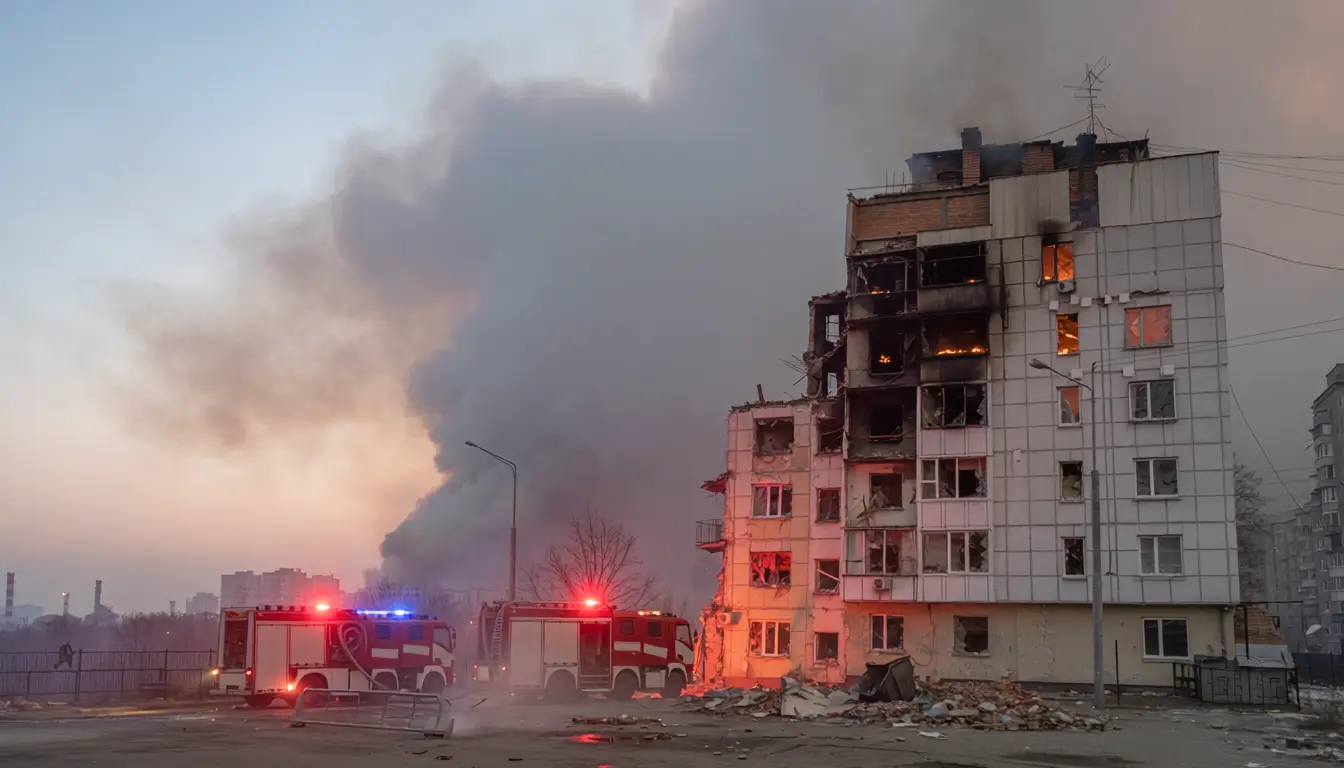
- Darnytskyi District Collapse: Mayor Vitali Klitschko reported that the most horrific collapse occurred when a heavy projectile sheared away six levels of a modern nine-story residential building, structurally imploding its central column.
- Widespread Conflagrations: Secondary fires erupted across the Desnianskyi and Pecherskyi districts, where burning debris fell onto administrative blocks and tight suburban clusters, triggering panic as thousands huddled underground.
Allies Urged to Break Delays on Air Defense Supply
As the true scale of the civilian carnage crystallized, Ukrainian Foreign Minister Andrii Sybiha issued a fierce, raw appeal to international coalition networks. Terming the incident an absolute “night of horror,” Sybiha rejected any attempts to label the massacre as a standard act of war retaliation.
“Our citizens are taking shelter inside metro tunnels while their homes burn above them,” Sybiha stated. “We are exercising our absolute, sovereign right to self-defense under Article 51 of the UN Charter. We urge our international partners to stop delaying vital logistical decisions. Ukraine needs advanced, high-precision air defense systems and interceptor missiles right now to guard our skies against this uninhibited aggression.”
With emergency services warning that the final death toll will likely escalate as structural block-by-block clearance progresses in the Darnytskyi district, the tragedy stands as a stark reminder of the escalating civilian cost of the conflict in mid-2026.