
Table of Contents
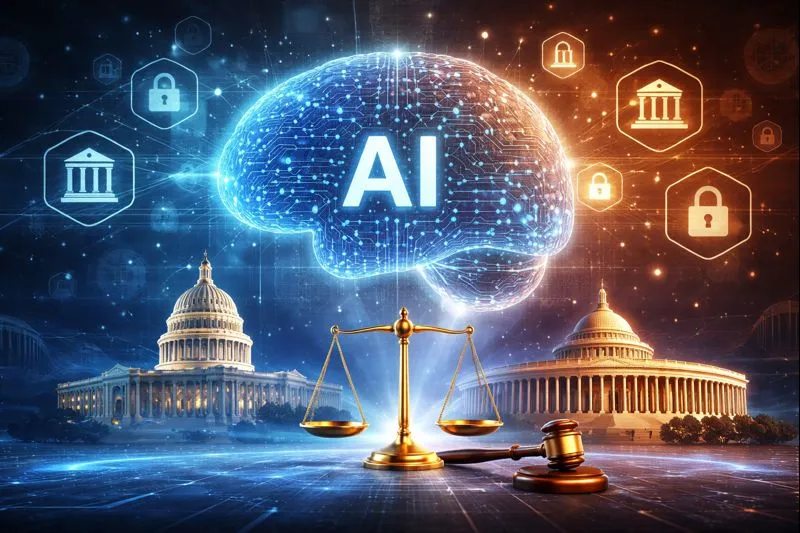
AI regulation in 2026 has become a top global priority as governments race to control the rapid expansion of artificial intelligence across industries, economies, and political systems. In 2026, AI is no longer just powering chatbots and recommendation engines – it is influencing elections, automating hiring decisions, generating hyper-realistic deepfakes, and reshaping entire job markets. This rapid expansion has triggered a global push to regulate AI before its risks outpace its benefits.
Across continents, policymakers are now scrambling to strike a balance between innovation and control, making AI regulation one of the most important global policy debates of 2026.
What Changed in 2025 That Forced Action?
The urgency around AI regulation didn’t emerge overnight. Several developments in late 2025 accelerated government intervention:
- AI-generated deepfake videos began circulating during election campaigns, blurring the line between truth and manipulation
- Autonomous AI agents started making financial and operational decisions with minimal human oversight
- Corporations adopted AI at scale, leading to concerns about mass job displacement
- Data misuse and privacy violations linked to AI models became harder to trace and regulate
These events made it clear that existing tech laws were insufficient for systems that can learn, adapt, and act independently.
How Different Regions Are Responding
Europe: Setting the Global Benchmark
Europe continues to lead the regulatory conversation with a risk-based approach to AI. Systems considered “high risk” – such as those used in healthcare, law enforcement, hiring, and credit scoring — are facing strict compliance requirements. Transparency, human oversight, and accountability are central pillars of Europe’s AI strategy.
Many global companies are now adjusting their AI products to meet European standards, effectively making these rules a de facto global benchmark.
United States: Innovation First, Regulation Catching Up
In the United States, the focus remains on protecting innovation while addressing national security and civil rights concerns. Instead of a single sweeping law, regulators are issuing sector-specific rules targeting election integrity, consumer protection, and defense applications.
Federal agencies are also pushing for clearer disclosure when AI is used to generate content, especially in political advertising and news distribution.
India: Balancing Growth and Safeguards
India’s approach reflects its position as both a fast-growing digital economy and a major technology talent hub. Policymakers are emphasizing ethical AI development, data protection, and bias prevention without stifling startups and innovation.
With AI increasingly used in governance, education, and public services, India is focusing on frameworks that ensure transparency while allowing flexibility for future technologies.
The Key Issues Governments Are Trying to Control
1. Deepfakes and Misinformation
One of the biggest fears in 2026 is the misuse of AI-generated audio, images, and videos. Deepfakes have become nearly indistinguishable from real footage, raising concerns about public trust, elections, and national security.
Governments are exploring watermarking systems, mandatory AI disclosure rules, and penalties for malicious use.
2. Job Displacement and Economic Impact
Automation powered by AI has improved efficiency but also raised alarms about workforce disruption. While new roles are being created, reskilling millions of workers remains a major challenge.
Some countries are considering AI impact assessments for large-scale deployments and incentives for companies that invest in workforce retraining.
3. Bias, Fairness, and Accountability
AI systems trained on biased data can reinforce discrimination in hiring, lending, and law enforcement. Regulators are now demanding clearer explanations of how AI models make decisions and who is responsible when they fail.
This shift marks a move away from “black box” AI toward explainable and auditable systems.
How Big Tech Is Responding
Major technology companies are publicly supporting “responsible AI” while quietly preparing for stricter oversight. Many have begun publishing transparency reports, opening parts of their models for audits, and investing in compliance teams.
At the same time, companies are lobbying governments to avoid overly restrictive rules that could slow innovation or push development underground.
What This Means for Businesses and Consumers
For businesses, AI regulation in 2026 means higher compliance costs but also clearer rules of the road. Companies that adapt early may gain a competitive advantage by building trust with users and regulators.
For consumers, regulation promises greater transparency, safer AI systems, and stronger protections against misuse. However, it could also slow the rollout of certain AI-powered features.
The Road Ahead
AI regulation is still evolving, and no single country has all the answers. What’s clear is that 2026 marks a turning point: governments are no longer asking if AI should be regulated, but how fast and how firmly.
As artificial intelligence becomes embedded in everyday life, the challenge for policymakers will be to ensure safety and accountability without suppressing the innovation that made AI transformative in the first place.