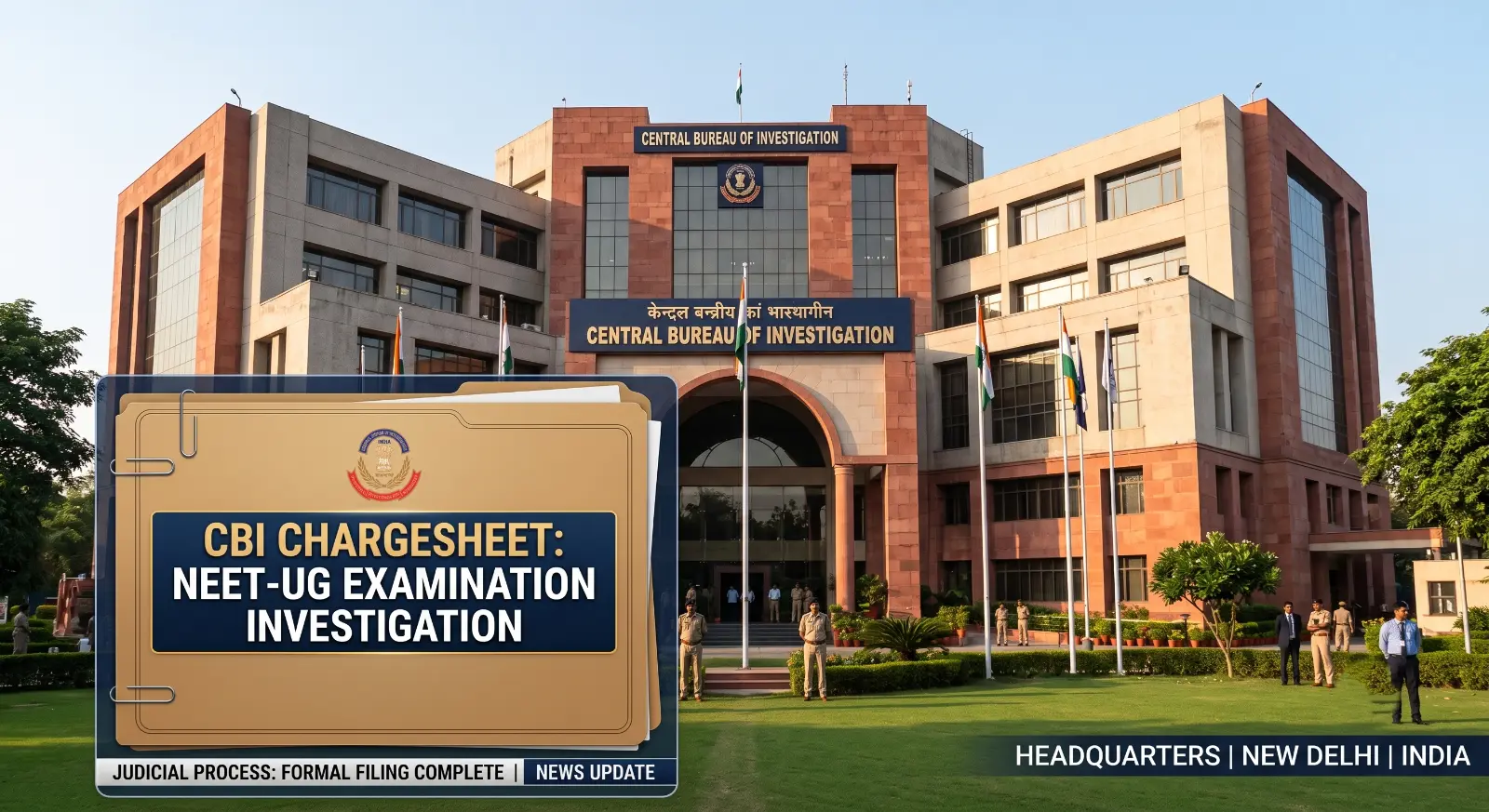
In a major legal milestone that establishes formal criminal accountability following weeks of nationwide student agitations and political fallout, the Central Bureau of Investigation (CBI) officially filed its first comprehensive chargesheet in the NEET-UG paper leak case on July 29, 2026. Submitted before the Special CBI Court, the extensive investigation document formally names 13 primary accused involved in the illicit retrieval, distribution, and monetization of the high-stakes medical entrance examination question paper.
The submission marks the first official evidentiary trail established by central agencies after weeks of protests across educational hubs led to administrative overhauls within the National Testing Agency (NTA), the resignation of Union Education Minister Dharmendra Pradhan, and the tabling of the Public Examinations (Prevention of Unfair Means) Amendment Bill in Parliament.
The Anatomy of the Leak: How the Syndicate Operated
According to detailed forensic, digital, and custodial interrogation evidence compiled by the CBI’s specialized investigation team, the breach was executed through an organized interstate syndicate operating across Patna, Ranchi, Hazaribagh, and New Delhi.
The investigation revealed that the breach occurred at a designated examination center in Hazaribagh, Jharkhand, where digital locks and physical security seals on paper trunks were compromised hours prior to the scheduled test time.
| CBI INVESTIGATION KEY FINDINGS | |
|---|---|
| PRIMARY BREACH POINT | School Vault / Courier Chain, Hazaribagh |
| SOLVE GANG LOCATION | Safe House Resort, Patna, Bihar |
| MODUS OPERANDI | Tampering trunk seals, high-speed scanning |
| EVIDENTIARY TRAIL | Burnt question paper remnants, UPI logs, confessed solver statements |
The question paper was scanned, transmitted digitally via encrypted messaging channels to a ‘solve gang’ comprising medical students and tutors assembled at a safe house in Patna, and subsequently memorized by a select group of candidates who paid sums ranging between ₹30 lakh and ₹50 lakh each.
Key Accused Named in the First Chargesheet
The 13 individuals named in the CBI’s first chargesheet face severe charges under relevant sections of the Bharatiya Nyaya Sanhita (BNS), including criminal conspiracy, cheating, forgery, breach of trust, and destruction of evidence.
- Nitish Kumar & Amit Anand (Patna Module): Alleged key conduits responsible for contacting aspirants, collecting advance payments, and arranging accommodation at the Patna safe house.
- Sanjeev Mukhia (Alleged Mastermind): Key kingpin accused of coordinating multiple paper-leak networks across Bihar and Jharkhand over the past decade.
- Ahsanul Haq & Imtiaz Alam (Hazaribagh Center In-Charges): School principal and vice-principal tasked with custodian duties of exam papers, charged with breaching security protocol to allow physical access.
- MBBS Solvers: Four senior medical students from prominent institutions in Patna and Ranchi hired to solve physics and chemistry modules within a strict two-hour window.
Impact on Legal Proceedings and Supreme Court Hearing
The filing of the CBI chargesheet provides concrete documentary evidence as the Supreme Court of India reviews petitions regarding the integrity of the examination system. During previous hearings, a Bench led by the Chief Justice of India emphasized that any decision regarding a re-examination or selective cancellation must be grounded in granular data establishing whether the leak was localized or widespread.
The CBI’s findings indicate that while the leak was orchestrated by a sophisticated network, the physical distribution of solved papers was contained to specific clusters in Bihar and Jharkhand, rather than a systemic digital compromise across all national centers.
Administrative and Legislative Ripple Effects
The formal filing of criminal charges comes amidst broader structural changes within India’s public examination framework:
- Public Examinations Amendment Bill: Parliament is evaluating stricter penal guidelines, classifying paper leaks as non-bailable offenses punishable by up to 10 years in prison and ₹1 crore fines.
- NTA Structural Overhaul: The Ministry of Education’s high-level committee is finalizing recommendations to transition future competitive exams to multi-stage or hybrid computer-based testing models.
- Withdrawal of FIRs Against Student Protesters: Simultaneously, state governments including Bihar, Maharashtra, and West Bengal have initiated steps to withdraw police complaints against peaceful student demonstrators following government assurances.
The submission of this initial chargesheet represents a critical step in transitioning the NEET-UG controversy from political discourse to judicial accountability, ensuring that those responsible for compromising the aspirations of millions of young students face the full weight of the law.