
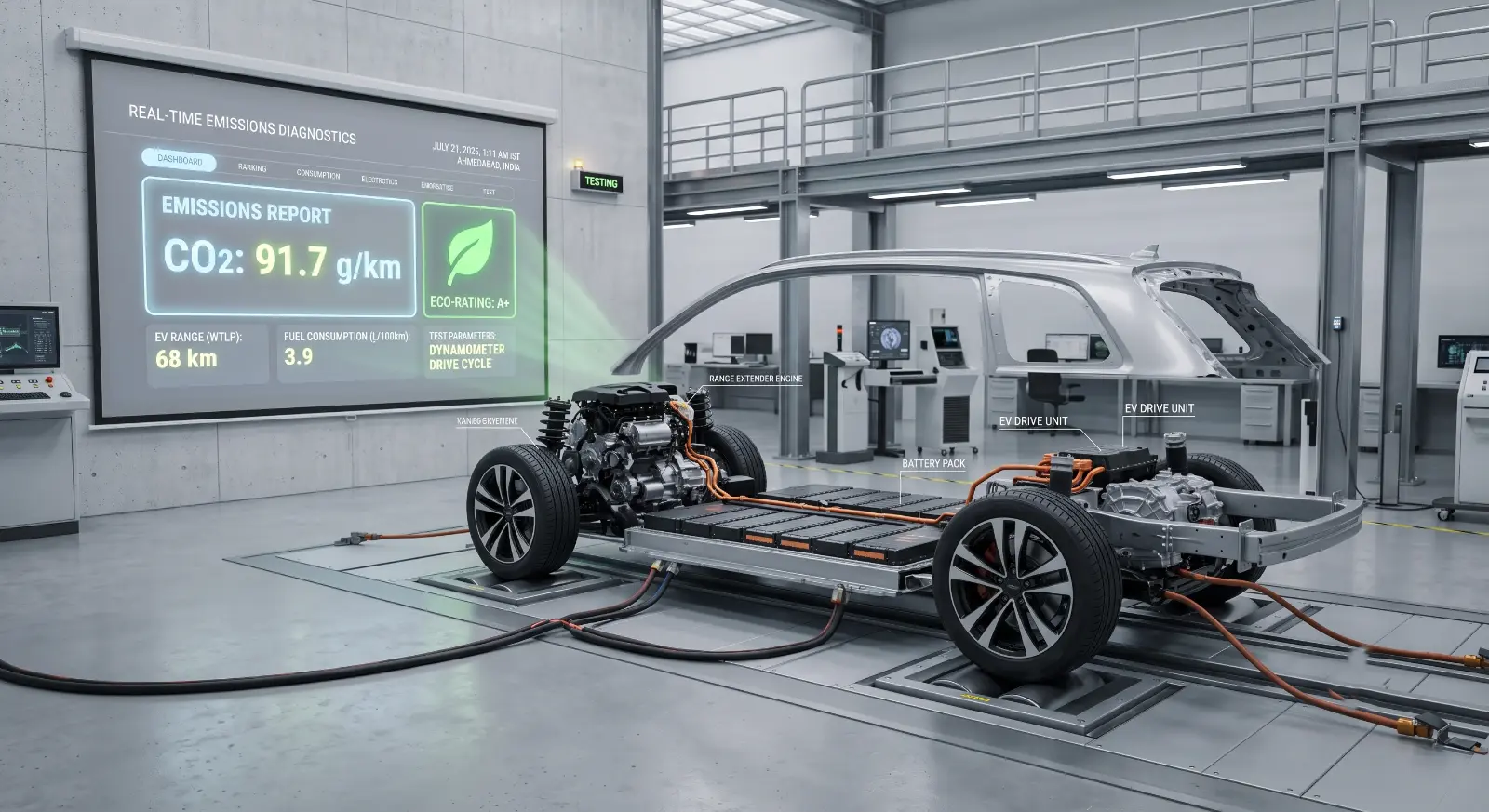
India’s automotive landscape is preparing for its most significant regulatory overhaul in half a decade. The Ministry of Power, in consultation with the Bureau of Energy Efficiency (BEE) and the Ministry of Heavy Industries, has officially published the long-awaited CAFE III draft norms fuel efficiency policy framework for public and stakeholder review. The progressive regulatory draft mandates significantly tighter Corporate Average Fuel Efficiency (CAFE) standards and carbon dioxide ($CO_2$) emission baselines for all passenger vehicle manufacturers operating in the country, with enforcement scheduled to take effect from April 1, 2027.
A major highlight of the newly proposed framework is its explicit policy support for alternative-fuel vehicles. In a major win for domestic automakers investing in green technologies, the draft gives special recognition and mathematical weightage to ethanol-blended flex-fuel engines, bio-CNG options, and hybrid-electric powertrains. By offering compliance credits for sustainable fuel adoption alongside traditional battery electric vehicles (BEVs), the government aims to accelerate the decarbonization of the country’s rapid passenger vehicle market.
The Emission Roadmap: Scaling Down Fleet Carbon Output
To appreciate the technological impact of the CAFE III draft norms fuel efficiency standards, one must examine how Corporate Average Fuel Efficiency operates. Unlike individual vehicle type-approval tests, CAFE targets apply to a manufacturer’s entire annual sales fleet average, calculating the weighted average of $CO_2$ emissions produced across all models sold.
Under the proposed CAFE-III phase (covering April 1, 2027 to March 31, 2032), fleet emission targets will undergo a steep reduction.
To meet these tighter fleet targets, auto manufacturers must balance sales of conventional internal combustion engine (ICE) models by scaling up production of low- and zero-emission alternatives:
- Ethanol & Biofuel Super-Credits: Vehicles designed to run on high-blend ethanol (such as E20 and E85 flex-fuel platforms) will receive specialized multiplier credits when computing total fleet average emissions.
- Strong Hybrid Recognition: High-efficiency self-charging hybrid vehicles will gain higher weightage factors, rewarding manufacturers that reduce urban fuel consumption without requiring immediate charging infrastructure.
- Electric Vehicle Multipliers: Battery electric vehicles (BEVs) will continue to carry significant regulatory credits, encouraging sustained investment in localized EV assembly and battery manufacturing pipelines.
Automotive Industry Reaction: Calibration and Investment Needs
The release of the CAFE III draft norms fuel efficiency document has initiated active technical reviews across major automotive OEMs (Original Equipment Manufacturers). Industry bodies like the Society of Indian Automobile Manufacturers (SIAM) have welcomed the clarity provided by the advance lead time ahead of the April 2027 rollout, while emphasizing the substantial capital investments required to re-engineer existing powertrain architectures.
Major operational considerations highlighted by auto executives include:
- Engine Calibration Costs: Upgrading existing petrol and diesel engine families to achieve higher thermal efficiency and lower carbon output requires substantial investment in advanced turbocharging, direct fuel injection, and lightweight chassis materials.
- Supply Chain Localization: Accelerating the local production of hybrid components, electric motors, and flex-fuel sensor arrays will be essential to maintain competitive pricing for budget-conscious car buyers.
- Consumer Shift Toward Clean Fuels: Automakers with strong existing portfolios in CNG, hybrid, and electric models are well-positioned to meet the new CAFE-III targets, whereas manufacturers reliant primarily on standard petrol platforms will need to fast-track alternative powertrain launches.
Driving Toward a Sustainable Mobility Future
The introduction of the CAFE III draft norms fuel efficiency standards aligns India’s automotive regulatory environment with global environmental benchmarks established in Europe and East Asia. By establishing predictable, long-term emission targets, the policy provides automakers with a clear roadmap for research, development, and capital allocation over the coming decade.
As stakeholder consultations proceed over the next sixty days, the finalized policy is expected to transform domestic vehicle showrooms – delivering cleaner, more fuel-efficient cars for Indian consumers while helping reduce national crude oil import bills and urban air pollution.