
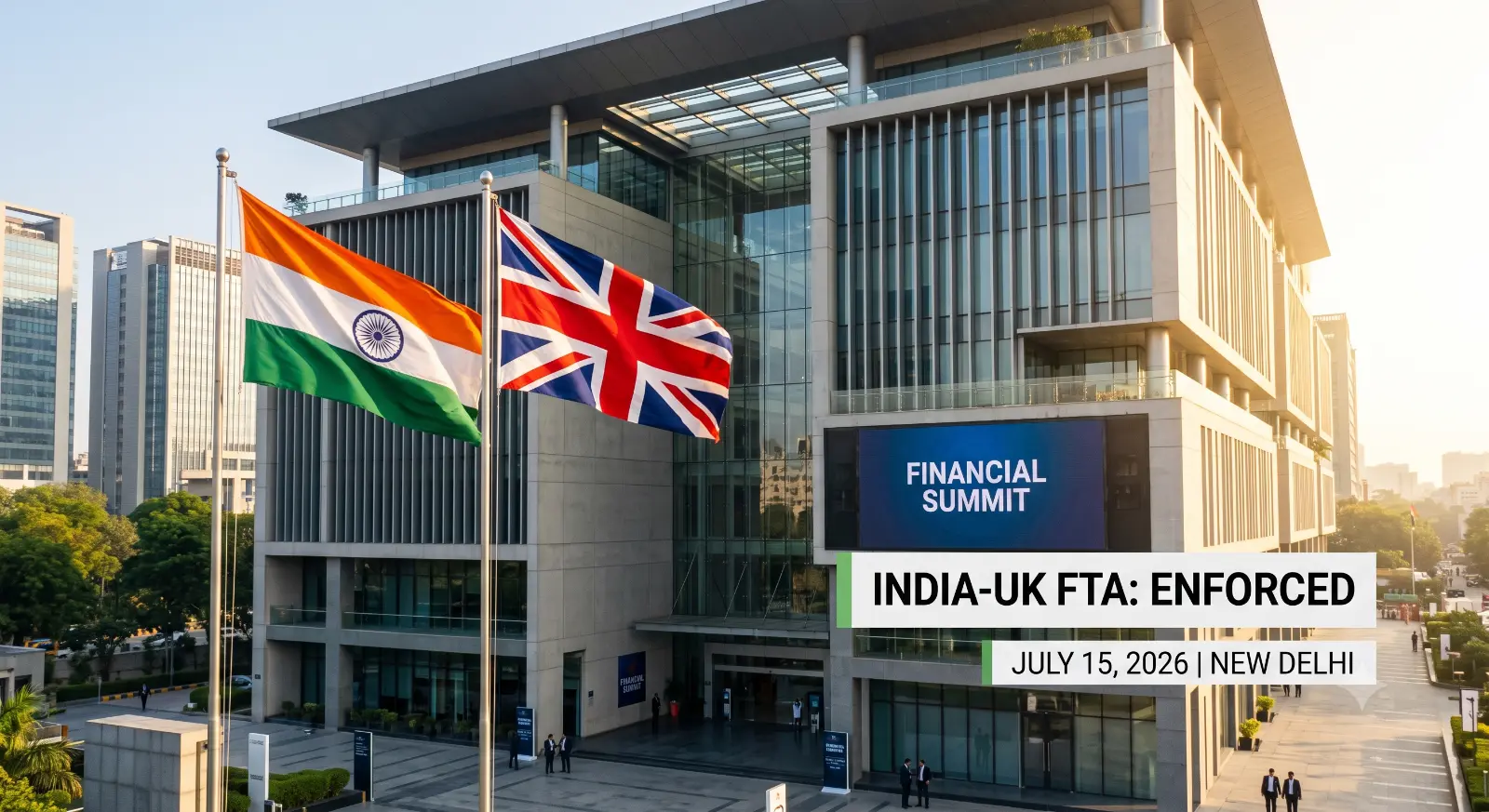
A monumental diplomatic and economic milestone has officially reset the parameters of international trade between South Asia and Europe. On July 15, 2026, the historic India UK Free Trade Agreement – formally operationalized under the legal structure of the Comprehensive Economic and Trade Agreement (CETA) – officially entered into force (Press Release). The activation of this massive bilateral accord marks the formal end of intense, multi-year negotiation rounds, establishing a progressive economic corridor between two of the world’s most powerful sovereign financial networks.
Briefing the media at the National Media Centre in New Delhi early this morning, Commerce Secretary Rajesh Agrawal hailed the enforcement as a structural triumph for the “Make in India” initiative. The landmark India UK Free Trade Agreement legally grants immediate zero-duty access to a spectacular 99% of Indian tariff lines arriving at British maritime ports. By systematically systematically lowering tariff and non-tariff friction zones, the treaty creates a multi-billion dollar canvas for manufacturing firms, software enterprises, and agricultural sectors across both nations.
The Tariff Takedown: Transforming Indian Exports
The immediate operational impact of the newly active India UK Free Trade Agreement will be experienced across high-volume domestic manufacturing clusters. Prior to today’s legislative enforcement, Indian exporters faced severe competitive disadvantages due to varying British import surcharges.
Under the finalized terms of the pact, these protective entry barriers have been permanently reduced to absolute zero.
The specific industrial sectors set to reap direct, immediate financial benefits from the zero-duty transition include:
- Processed Foods and Fisheries: Historical British tariffs scaled up to 70% on processed agricultural outputs and 21% on fresh marine harvests have dropped to zero instantly, opening major export pathways for rural fishermen and agro-conglomerates.
- Textiles, Apparel, and Footwear: The long-suffering Indian garment sector gains a massive edge as UK import taxes of up to 12% on clothing and 16% on leather goods are systematically eliminated.
- Engineering and Auto Parts: Domestic auto component manufacturers will bypass a former 18% structural duty baseline, integrating Indian component production directly into the primary assembly grids of British industrial firms.
The Service Masterstroke: The Double Contribution Convention
While the physical movement of cargo forms the visible backbone of the treaty, the absolute crown jewel for the Indian technology sector lies within the service mobility clauses of the India UK Free Trade Agreement. Simultaneously coming into effect alongside the core trade metrics is the Double Contribution Convention (DCC), a specialized social security arrangement long sought by the Indian IT council.
Under the revolutionary guidelines of the DCC, Indian engineering professionals and software experts temporarily posted to the United Kingdom on corporate assignments will be fully exempt from contributing to the UK social security system for a period of up to 5 years.
Historically, Indian companies were forced to sink hundreds of millions annually into the British social safety net for short-term workers who could never legally claim the benefits. By wiping away this double-taxation trap, the agreement dramatically lowers the operational deployment costs for Indian IT consulting majors, enhancing the global competitiveness of local technological talent.
Reciprocal Adjustments: The British Inflow and Domestic Protections
To secure these unprecedented concessions, New Delhi has introduced an array of calculated, phased market openings for British corporations. The most notable adjustment materializes inside the automotive sector, where India will allow the phased import of a restricted 3,78,000 conventional-engine passenger vehicles from the UK at concessional duties over the next 15 years. The current astronomical import tariff of 110% on fully built British cars will scale down to a flat 10% in strict phases, with premium alcoholic beverages like Scotch whisky also experiencing a gradual tariff reduction over time.
Crucially, the Indian negotiating team has maintained an iron-clad safety shield over the country’s vulnerable agricultural and domestic electronics sectors. The India UK Free Trade Agreement explicitly excludes highly sensitive areas – such as fresh dairy, native millets, edible oils, smartphone assemblies, and gold bars – from receiving any form of tariff concession.
Furthermore, rigid Rules of Origin have been hardcoded into the treaty frameworks, ensuring that external third-party manufacturing countries cannot exploit the treaty to dump cheap goods into the Indian market. By combining aggressive export market capture with robust domestic economic insulation, the operationalization of this trade deal charts an empowering pathway toward a more globally integrated and resilient Indian economy.