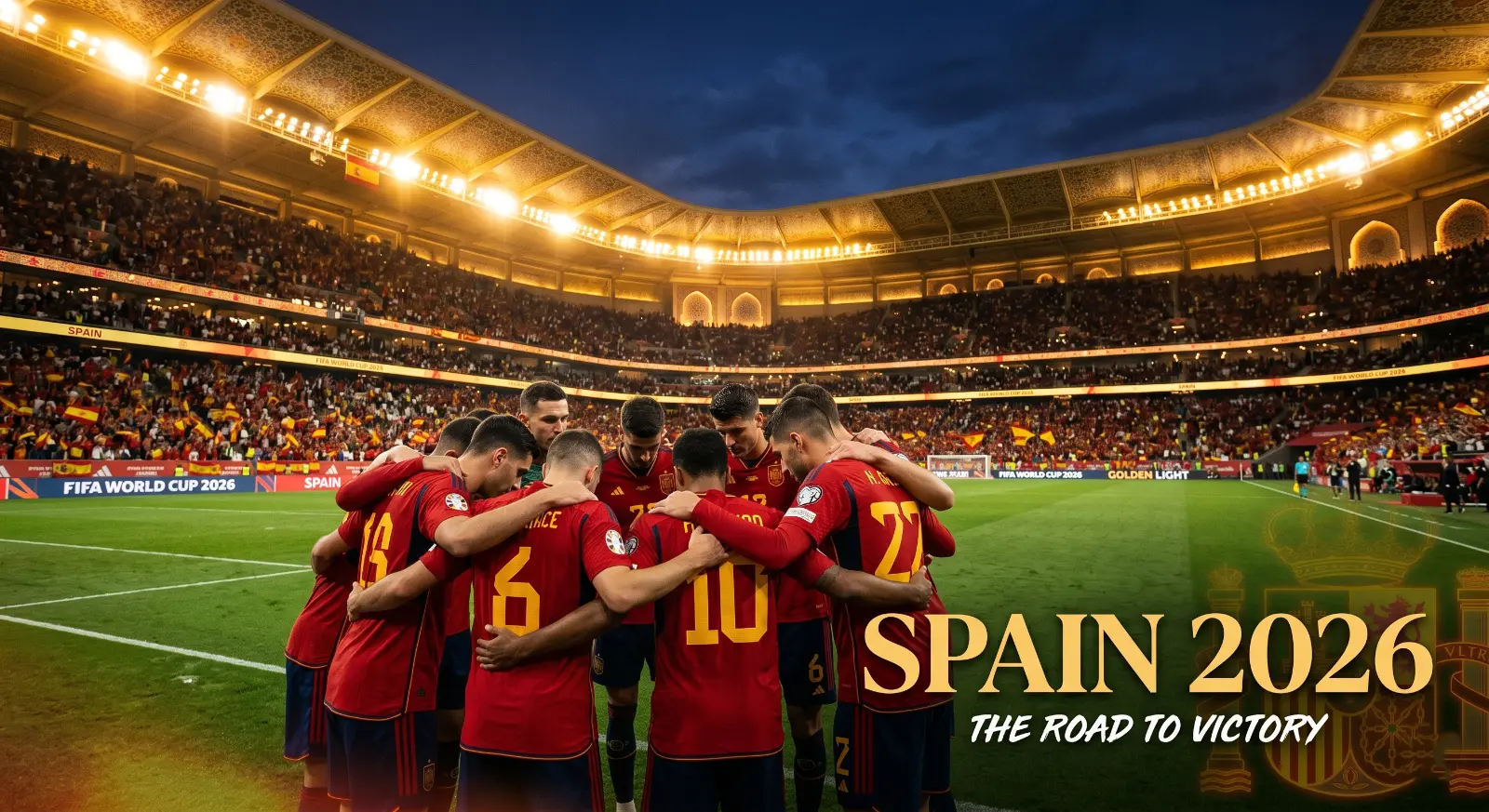
Ask any football statistician, bookmaker, or informed tactical observer to name the single team most likely to lift the FIFA World Cup trophy at MetLife Stadium on July 19, 2026, and the answer comes back with striking consistency: Spain.
This is not a sentimental verdict. It is not built on nostalgia for the tiki-taka era that dominated the late 2000s and early 2010s. It is built on the present – on a Spain side that sits at the top of the FIFA world rankings heading into the tournament, that won Euro 2024 without losing a single match, and that possesses the deepest, most coherent squad in international football. When you strip away the hype and the alternative narratives, the data keeps pointing back to the same team.
But data is not destiny. Here is the complete case for why Spain should win the 2026 FIFA World Cup – and the genuine threats that could prevent it.
 SPAIN AT A GLANCE – FIFA WORLD CUP 2026 SPAIN AT A GLANCE – FIFA WORLD CUP 2026FIFA World Ranking (June 2026): No. 1 Head Coach: Luis de la Fuente World Cup Group: Group H – Cape Verde, Saudi Arabia, Uruguay Previous World Cup Titles: 1 (2010, South Africa) Previous European Championship Titles: 4 (1964, 1984, 2008, 2012, 2024) Most Recent Major Tournament: Euro 2024 Champions – unbeaten throughout Star Players: Lamine Yamal, Pedri, Álvaro Morata, Dani Carvajal, Nico Williams |
The Squad: A Generation Built to Win Everything
Spain’s greatest asset in 2026 is not a single player. It is squad depth – the kind of embarrassment of riches that means Luis de la Fuente regularly leaves out players who would walk into almost any other nation’s first XI. This is the inevitable product of two decades of La Masia and elite youth development across Spanish clubs, combined with the competition for places that comes from having world-class talent at every position.
Spain 2026 – Predicted Squad Depth by Position
| Position | First Choice | Second Choice | Assessment |
| Goalkeeper | Unai Simón | David Raya | Elite shot-stopping, commanding in the box. Simón’s experience gives him the nod. |
| Right Back | Dani Carvajal | Pedro Porro | Carvajal is one of the best right backs in history. Still world-class at 34. |
| Centre Back | Aymeric Laporte | Pau Cubarsí | Laporte’s experience pairs with Cubarsí’s extraordinary composure for a 20-year-old. |
| Centre Back | Robin Le Normand | Nacho Fernández | Le Normand’s physical presence; Nacho is the most experienced man in the group. |
| Left Back | Alejandro Balde | Grimaldo | Balde’s explosive pace down the left is irreplaceable when Spain are attacking. |
| Midfielder | Rodri | Martín Zubimendi | Rodri is the world’s best defensive midfielder. His role is foundational. |
| Midfielder | Pedri | Dani Olmo | Pedri’s creativity at the base of Spain’s attack is the system’s true heartbeat. |
| Midfielder | Fabián Ruiz | Mikel Merino | Fabián provides the late runs and goalscoring threat from deep that Spain demand. |
| Right Wing | Lamine Yamal | Nico Williams | The world’s most exciting 18-year-old. Nico Williams would start for any other nation. |
| Left Wing | Nico Williams | Dani Olmo | Williams’s pace on the left mirrors Yamal’s directness on the right – impossible balance. |
| Centre Forward | Álvaro Morata | Joselu / Oyarzabal | Morata’s link play and intelligent movement is perfect for Spain’s system. |
The Most Important Player: Rodri
In any discussion of Spain’s squad, one name demands specific attention that gets systematically under-served by the casual football narrative: Rodrigo Hernández Cascante, universally known as Rodri.
The Manchester City and Spain defensive midfielder is, by the assessment of most football analysts, the best midfielder in the world in 2026. His reading of the game is extraordinary – he intercepts passes before they are made, positions himself in spaces that close down opposition transitions before they begin, and distributes the ball with a range and accuracy that turns defence into attack in three touches.
Spain without Rodri – as demonstrated in matches where he has been absent – is a fundamentally different team. With him, their defensive structure is almost impenetrable. Every other element of Spain’s attacking brilliance flows from the platform he provides.
| Rodri does not play football. He controls the rate at which football is allowed to happen. That is a different, rarer skill. – Planet Headline Analysis |
The System: How Luis de la Fuente’s Spain Works
Understanding why Spain are favourites requires understanding their tactical system – not the simplified ‘possession football’ label that gets attached to every Spanish team, but the specific, evolved approach that Luis de la Fuente has built since taking over in 2023.
Formation and Structure
Spain play a 4-3-3 that morphs into a 4-2-3-1 in possession and compresses to a 4-4-2 medium block out of possession. The shape is fluid because the players are instructed to read game states rather than maintain positional rigidity. This is the key evolution from the Tiki-Taka era: this Spain press aggressively when they lose the ball rather than accepting the opponent’s possession.
Spain 2026 – Tactical System Breakdown
| Phase of Play | Spain’s Approach | Key Personnel |
| In Possession (Build-Up) | Goalkeeper and centre backs circulate; fullbacks push high to create 3v2 in wide areas; Rodri drops to form back three. | Rodri, Laporte, Balde, Carvajal |
| In Possession (Final Third) | Yamal and Williams stay wide to stretch backline; Pedri and Fabián arrive late into the box from deep positions. | Yamal, Williams, Pedri, Fabián Ruiz, Morata |
| Pressing (Without Ball) | High press triggered by Morata – front three compresses, forcing long ball or back pass; midfield intercepts second balls. | Morata, Yamal, Williams, Pedri |
| Defensive Shape (Deep Block) | Compact 4-4-2 with Williams and Yamal tracking back; Rodri protects the central channel; fullbacks refuse to be stretched. | Rodri, Le Normand, Laporte, Carvajal |
| Transitions (Counter-Attack) | Immediate vertical passes to Williams and Yamal in behind; Pedri drives forward into space; Morata makes runs to exploit gaps. | Williams, Yamal, Pedri, Morata |
The Yamal-Williams Dynamic
The most unique element of Spain’s attack is the simultaneous presence of two world-class, pace-equipped wide forwards – Lamine Yamal on the right and Nico Williams on the left. This pairing represents the most dangerous wide combination at this World Cup.
Yamal cuts inside from the right onto his stronger left foot, creating shots and through-balls. Williams runs at defenders in straight lines with devastating pace, targeting the space behind opposing right backs. Morata, intelligent enough to know he is not the star of this system, makes the runs that pull centre-backs wide and creates the gaps that Pedri and Fabián Ruiz exploit from deep.
Defensive coaches across the world have spent the past two years trying to find a reliable way to stop this combination. None has done so consistently.
Euro 2024: The Blueprint for 2026 Success
Spain’s World Cup credentials are not theoretical. They were tested, refined, and validated at Euro 2024 – the most recent major international tournament, held across Germany in the summer of 2024.
Spain won the tournament without losing a single match across seven games. They defeated Croatia, Italy, Germany (in the quarter-final – the most emphatic result of the tournament), France (in the semi-final), and England in the final. They did not face a single match in which they were comprehensively outplayed. They adapted their system to opponents throughout. And they delivered when the knockout pressure was at its maximum.
| 7 Euro 2024 Matches Played | 15 Goals Scored | 4 Goals Conceded |
| 7/7 Matches Won | 62% Avg. Possession % | 112 Avg. Distance Covered (km) |
The 2026 World Cup is a different competition – expanded to 48 teams, with a new Round of 32, played in North American heat across a longer period. But the fundamental truth of Spain’s Euro 2024 campaign applies: this is a team that has already proven it can win a major tournament under pressure, against world-class opposition, without conceding its identity.
| Winning Euro 2024 was not lucky. Spain were the best team. That is the most important sentence in this entire analysis. – Planet Headline |
Group H Analysis: Spain’s Path Through the Group Stage
Spain were drawn into Group H alongside Cape Verde, Saudi Arabia, and Uruguay. This is a manageable group for a team of Spain’s quality, but it is not without its trap doors.
The Three Group Stage Matches
Spain Group H – Match-by-Match Prediction
| Match | Date | Our Prediction | Key Context |
| Spain vs Cape Verde | June 12, 2026 | Spain win 3-0 | Cape Verde’s AFCON quality will make this competitive for 45 minutes. Spain’s depth ends it quickly. |
| Spain vs Saudi Arabia | June 17, 2026 | Spain win 3-1 | Saudi Arabia upset Argentina in 2022. Spain cannot underestimate this match. Expect a nervy first half. |
| Spain vs Uruguay | June 23, 2026 | Spain win 2-1 | Uruguay’s Darwin Núñez and attacking quality makes this the group’s standout match. Spain’s toughest test before the knockouts. |
Spain advance as Group H winners with nine points, setting up a Round of 32 clash against a third-placed qualifier – almost certainly from the adjacent bracket area. The significant advantage of topping the group is a favourable path into the Round of 16 and a potential bracket that avoids Argentina and Brazil until the semi-final at the earliest.
The Realistic Path to the Final
Spain’s Projected Knockout Path – FIFA World Cup 2026
| Stage | Projected Opponent | Difficulty | Spain’s Edge |
| Round of 32 | Best 3rd team (Group G/H area) | Low | Squad depth means de la Fuente can rotate without losing quality. Yamal rested. |
| Round of 16 | Uruguay or Egypt | Medium | Both are competitive. Spain’s tactical flexibility gives them the edge in close games. |
| Quarterfinal | Potential Germany or Portugal | High | The first genuinely elite test. Spain’s midfield control vs Germany’s attacking press. |
| Semifinal | Potential England or France | Very High | Either semifinal is a final-quality match. Spain’s experience from Euro 2024 is their advantage. |
| Final | Argentina or Brazil | Extreme | Spain know how to win on the biggest stage. Qatar 2022 showed the gap between ambition and execution; Spain bridge it. |
The Threats: What Could Stop Spain?
Spain are favourites, not certainties. Football is not an algorithm, and the 2026 World Cup’s expanded format – more matches, more knockout rounds, more opportunities for exhaustion, injury, and tactical evolution – creates risk even for the most dominant side. Here are the realistic threats:
Threat 1: The Rodri Injury Problem
Spain’s dependence on Rodri is their most significant structural vulnerability. If he picks up an injury during the tournament – in a group stage match, in a Round of 32 encounter – Spain’s defensive midfield becomes noticeably less dominant. Martín Zubimendi is a quality replacement, but the drop in overall control is measurable. Every Spain supporter watching a challenge go in on Rodri holds their breath for exactly this reason.
Threat 2: The Fatigue Factor
The 2026 World Cup runs for 39 days across North American timezones with heat and humidity as significant environmental factors – particularly in Miami, Dallas, and Mexico City. A team that plays seven matches over five weeks, travelling between venues, faces legitimate physical depletion. Spain’s squad depth helps, but the cumulative effect of a deep tournament run on key players like Pedri and Yamal – both of whom are naturally slight in build – is a legitimate concern.
Threat 3: The Saudi Arabia Trap Door
Saudi Arabia defeated Argentina in 2022 in what remains the single greatest World Cup upset of the modern era. Saudi Arabia are in Spain’s group. Spain know this. De la Fuente knows this. But complacency in international football is not always a choice – sometimes it is the consequence of routine, of early lead taking, of an opponent playing the match of their lives. Spain must approach the Saudi Arabia fixture with the intensity of a knockout match.
Threat 4: France in the Knockout Rounds
France are the one team in this tournament who can match Spain for tactical sophistication, squad depth, and tournament experience. If Spain and France meet in the semi-final – the most likely bracket scenario – it will be the most tactically complex match of the tournament. France’s ability to absorb pressure and break quickly in transition is specifically designed to punish teams that dominate possession. Spain must be prepared for a version of their semi-final against France that looks very different from the Euro 2024 meeting.
Spain’s World Cup History: Context for 2026
Spain won their first and only FIFA World Cup title in 2010, defeating Netherlands 1-0 in the final through Andrés Iniesta’s extra-time goal in Johannesburg. That generation – Xavi, Iniesta, Villa, Casillas, Puyol, Ramos – dominated a seven-year period that produced three major international trophies (Euro 2008, World Cup 2010, Euro 2012) and redefined how the world thought about football.
Since then, Spain’s World Cup record has been inconsistent: eliminated in the group stage in 2014, quarter-finalists in 2018 (beaten on penalties by Russia), eliminated in the Round of 16 in 2022. But the cycle has turned. The new generation is ready. And the 2026 World Cup is the platform they were built for.
Spain – World Cup & Major Tournament History
| Tournament | Result | Key Player | Notable Moment |
| 2010 World Cup | CHAMPIONS | Andrés Iniesta | Iniesta’s extra-time winner in the final vs Netherlands |
| 2014 World Cup | Group Stage Exit | Xavi Hernández | Shock 5-1 defeat to Netherlands ended an era |
| 2018 World Cup | Round of 16 (Pens) | David de Gea | De Gea’s missed penalty in shootout vs Russia |
| 2022 World Cup | Round of 16 | Álvaro Morata | Morocco’s tactical mastery ended Spain’s campaign |
| Euro 2024 | CHAMPIONS | Lamine Yamal | 16-year-old Yamal announced Spain’s new era vs France |
| 2026 World Cup | OUR PREDICTION: WIN | Lamine Yamal/Pedri | The next great Spain team completing the next great story |
Our Verdict: Spain Win the 2026 FIFA World Cup
The case for Spain is not romantic – it is forensic. They have the world’s best midfielder protecting their defence. They have the most tactically advanced head coach at the tournament. They have two of the most dangerous wide forwards in world football operating simultaneously. They have depth at every single position. They have recent tournament experience proving their system works under maximum pressure.
None of that guarantees the trophy. Argentina were defending champions and fell to the Saudis on day one. France had the most talented squad in 2022 and were beaten by a penalty shootout in the final. Football reserves the right to be irrational at any moment.
But if you strip the irrational elements away and ask which team, given 100 attempts at this tournament, would win it most often – the answer is Spain. In a single-elimination tournament, the best team does not always win. Over 100 attempts, they almost always do.
| ⚽ PLANET HEADLINE’S SPAIN 2026 PREDICTION Group Stage: Spain top Group H with 9 points (3 wins, 8+ goals scored) Round of 32: Spain win comfortably – Yamal and Williams both score Round of 16: Spain 2-0 vs Uruguay – tactical dominance, clean sheet Quarterfinal: Spain 1-0 Germany – Rodri controls the match, Morata decides it Semifinal: Spain 2-1 France – Pedri scores the winner in extra time FINAL: Spain 2-1 Argentina – Lamine Yamal wins the Golden Ball. Spain are World Champions. |
FAQ
-
Is Spain the favourite for the 2026 World Cup?
Spain entered the tournament as one of the primary favourites to lift the trophy. Following the announcement of the tournament groups, betting markets positioned them as a narrow favourite to win the 2026 World Cup, closely followed by perennial contenders like England and France.
-
Who is Spain’s best player at World Cup 2026?
The current Spanish squad is widely praised for its depth and blend of experienced leaders and explosive young talent. While players like Rodri and Fabián Ruiz provide essential star power and technical control in midfield, teenage sensation Lamine Yamal has become the primary focal point of the team’s attack. His creativity and flair on the wing have made him the standout name expected to carry significant creative responsibility for La Roja during this campaign.
-
What group is Spain in at the 2026 World Cup?
Spain has been drawn into Group H for the 2026 FIFA World Cup. They are joined in this group by Cabo Verde, Saudi Arabia, and Uruguay.
-
Has Spain ever won the World Cup?
Yes, the Spanish men’s national team has won the FIFA World Cup once, securing the title in 2010. During that historic tournament in South Africa, Spain defeated the Netherlands 1–0 in the final thanks to an iconic extra-time goal by Andrés Iniesta. Additionally, the Spanish women’s national team also holds a World Cup title, having won the 2023 FIFA Women’s World Cup, making Spain one of the few nations to have achieved success in both the men’s and women’s tournaments.