A humanitarian crisis is unfolding rapidly across South America. In the late afternoon of June 24, 2026, northwestern and central Venezuela were struck by two of the most powerful, consecutive earthquakes the country has witnessed in more than a century.
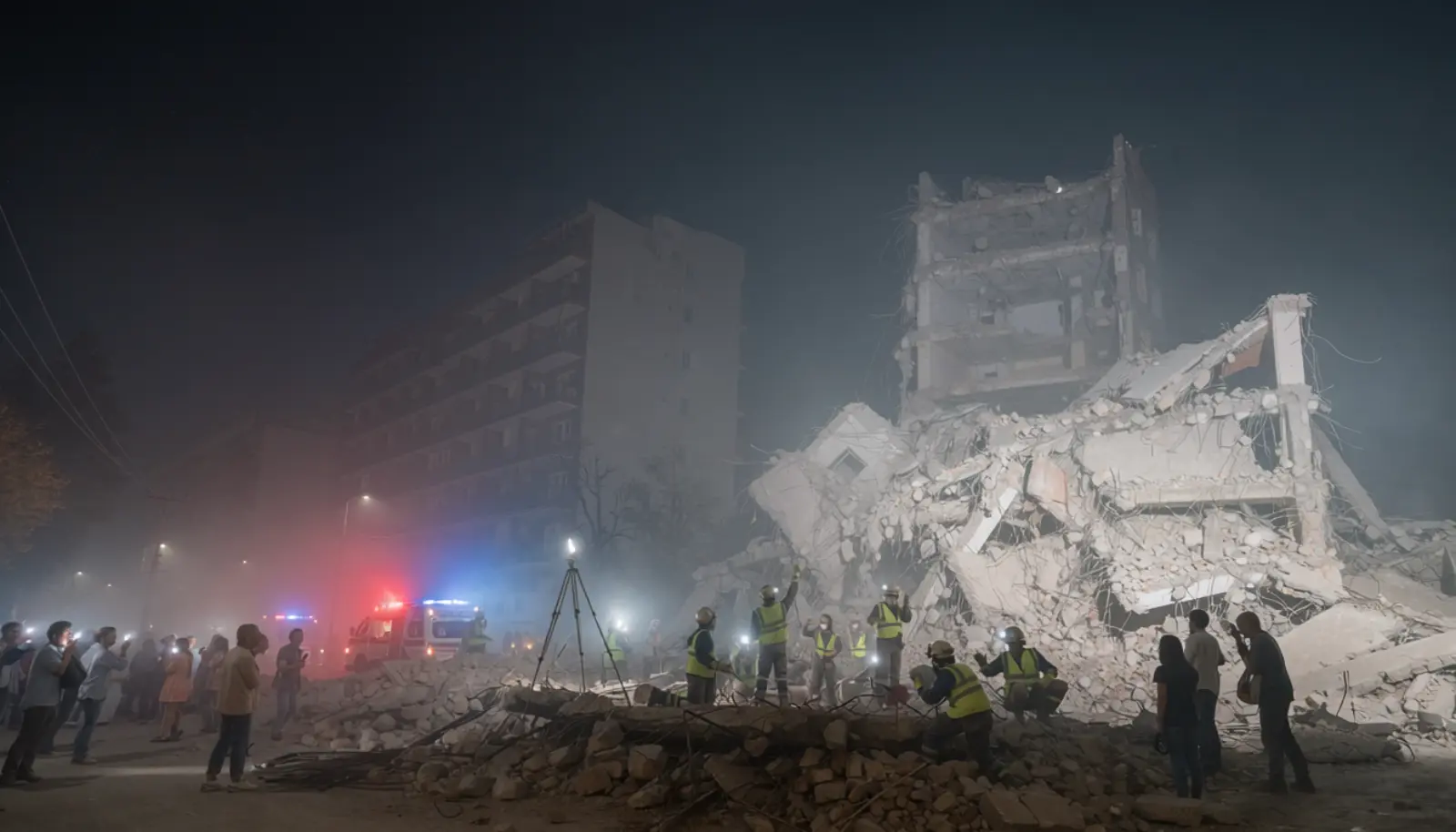
The dual tectonic ruptures, occurring less than a minute apart, have leveled multi-story residential high-rises, heavily fractured critical social infrastructure, and thrown the capital city of Caracas into a state of absolute terror.
Acting President Delcy Rodríguez immediately addressed the nation to declare a formal National State of Emergency. In her initial broadcast, she confirmed that at least 32 people have been killed and over 700 individuals rushed to emergency medical facilities. However, with communication arrays severely disabled and thousands of citizens believed to be trapped beneath concrete wreckage, official relief agencies fear the true casualty count could skyrocket exponentially in the coming days.
The Anatomy of the Disaster: Dual Strike-Slip Shocks
According to technical telemetry from the United States Geological Survey (USGS), the disaster materialized as a double-shock sequence generated by shallow strike-slip faulting along the active boundary of the Caribbean and South American tectonic plates.
The Timeline of Terror
- The Foreshock (6:04 PM Local Time): The first event registered as a massive 7.2 magnitude earthquake. The epicenter was located in the Veroes municipality of the Yaracuy State, roughly 21 kilometers west of the coastal community of Morón, rupturing at a depth of 21.9 kilometers.
- The Mainshock (6:05 PM Local Time): Merely 38 seconds later – before citizens could even fully evacuate swaying structures – a secondary, more violent 7.5 magnitude earthquake ripped directly east of the first epicenter. This shallower shock struck at a perilous depth of just 10 kilometers, compounding the destruction exponentially.
The physical shaking was so violent that it triggered immediate automatic landslide warnings across Venezuela’s mountainous coastal ranges. Tremors were powerful enough to be felt clearly in neighboring northeastern Colombia, northern Brazil (including the cities of Manaus and Belém), and across nearby Caribbean islands like Aruba, Bonaire, and Curaçao.
Seismic Event Overview
| Characteristic | Foreshock Details | Mainshock Details |
| Magnitude | $M_w\ 7.2$ | $M_w\ 7.5$ |
| Local Time | 18:04:33 VET | 18:05:11 VET |
| Epicenter Location | Veroes, Yaracuy State (Near Morón) | Veroes, Yaracuy State |
| Depth | 21.9 km (13.6 miles) | 10.0 km (6.2 miles) |
| Maximum Intensity | MMI IX (Violent) | MMI IX (Violent) |
| Primary Structural Impact | Severe foundational destabilization | Total structural collapses |
Caracas in Ruins: Structural Failures and Urban Chaos
The capital city of Caracas, situated roughly 168 kilometers east of the twin epicenters, bore the brunt of the structural devastation due to local soil amplification.
Interior Minister Diosdado Cabello reported that the affluent northern municipalities of Altamira and Los Palos Grandes have experienced alarming structural emergencies. At least three prominent high-rise residential complexes completely pancaked in Altamira, including a well-known 22-story tower.
Witnesses described horrific scenes as the shockwaves systematically sheared away exterior walls, exposing living rooms and furniture to the open air before the structures disintegrated into blinding plumes of grey dust.
“The building didn’t just shake; it violently tossed us from side to side,” recounted Hector Ricci, a resident of central Caracas. “As we scrambled down the stairwells, the walls were actively cracking open around us. We are all staying on the asphalt tonight – nobody dares go back inside.”
Compounding the crisis, June 24 is a prominent national holiday in Venezuela commemorating the historic 1821 Battle of Carabobo. Because businesses and schools were closed, the vast majority of families were aggregated inside their homes rather than spread out across commercial offices when the buildings failed.
Infrastructural Collapse and the Threat of Aftershocks
The physical toll on Venezuela’s broader logistical network has brought emergency services to a grinding crawl:
- Airport Closure: The country’s primary aviation gateway, the Simón Bolívar International Airport (Maiquetía) in La Guaira, sustained devastating structural fractures to its terminal roofs and runway control arrays. Acting President Rodríguez confirmed the airport is closed indefinitely, forcing all incoming humanitarian or commercial flights to halt.
- Utility Blackout: Power lines have snapped across multiple states including Miranda, Aragua, Carabobo, and Falcón. Telecommunication networks are completely dark or highly intermittent, cutting off entire neighborhoods from communicating with emergency dispatchers.
- Tsunami False Alarm: In the immediate aftermath, the Pacific Tsunami Warning Center issued localized tsunami advisories for Puerto Rico, the Virgin Islands, and the Dominican Republic. Thankfully, those warnings have since been rescinded as sea-level sensors stabilized.
The USGS PAGER Warning
The USGS Prompt Assessment of Global Earthquakes for Response (PAGER) system has issued a grim outlook. Their automated predictive algorithms estimate a 39% probability of the final death toll landing between 1,000 and 10,000 fatalities, and a chilling 37% probability that casualties could reach between 10,000 and 100,000 individuals.
With more than 20 significant aftershocks exceeding a magnitude of 5.0 recorded within the first few hours, rescue workers face the continuous peril of secondary collapses as they dig through unreinforced masonry.
International Emergency Responses
As the true scale of the crisis crystallizes, regional neighbors have bypassed political divides to mobilize humanitarian assets.
The Colombian Red Cross has immediately mobilized its specialized K9 urban search and rescue vanguards along the western border, standing by for direct deployment. Similarly, emergency crisis rings have been activated by humanitarian networks in Argentina, Chile, and Brazil.
From Washington, U.S. officials expressed deep sorrow over the escalating casualty counts, promising to coordinate with international aid groups to funnel medical supplies and technical search apparatus into the disaster zones. The primary focus for the next 48 hours remains firmly on the Golden Window of survival – extricating those trapped beneath the mountain of concrete dust in Caracas and La Guaira.
From India, PM Narendra Modi expressed condolences to the government and people of Venezuela.
Emergency Notice for Citizens: The Venezuelan Civil Protection network urges all residents in north-central states to remain outdoors in open spaces such as parks or avenues. Do not attempt to re-enter buildings that exhibit visible wall fractures. Monitor local emergency radio frequencies for updates on clean water distribution and mobile field hospitals.